

Consumer demand for personal recovery tools has shifted dramatically over the past two years. The global wellness device market is marching toward record revenues by 2026, driven by an aging population, remote workers, and active lifestyle consumers.
For brands and B2B buyers, offering the best foot massager is no longer just about picking a generic off-the-shelf unit. Modern consumers demand targeted therapy, silent mechanics, smart digital controls, and clean industrial designs that fit home decor.
Whether you sell on Amazon, manage an established DTC store, or distribute therapeutic devices, your product selection directly impacts your bottom line. Higher return rates, warranty claims, and shipping costs can quickly wipe out healthy sales volumes.
Experienced manufacturers like Jingtuo help consumer brands navigate these engineering and sourcing decisions early. If you plan to expand your catalog or upgrade your private label inventory for the upcoming product cycle, contact our product specialists today for custom OEM/ODM solutions and direct factory quotes.
.webp?t=1792394189908 "best foot massager")
1. Consumer Trends Reshaping Demand in 2026
Shoppers evaluate foot massagers with much higher scrutiny than they did five years ago. To stand out in a competitive market, brands must understand what features define the best foot massager in the eyes of end users.
Multimodal Therapy: Shiatsu, Airbags, and Heat
Standalone mechanical rollers no longer satisfy consumer expectations. The top-rated models integrate multiple massage modalities into a coordinated, fluid cycle:
- Deep Kneading Shiatsu: Underfoot rollers targeting the plantar fascia, heel, and arch nodes.
- Dynamic Air Compression: Multi-chamber TPU bladders that wrap the instep and ankles, rhythmically squeezing to push pooled blood back toward the heart.
- Targeted Far-Infrared Heat: Warmth that penetrates deep muscle tissue rather than merely heating the surface fabric.
Smart Connectivity and Adaptive Programs
A smart foot massager 2026 edition needs modern software support. End users want tailored routines rather than basic high/medium/low settings. Leading units offer app integration via Bluetooth or Wi-Fi, allowing users to save custom pressure routines.
In advanced models, intelligent load sensors detect foot resistance. The motor dynamically balances its torque, avoiding painful pinching for sensitive arches while delivering firm pressure to worn-out athletic feet.
Home-Centric Aesthetics and Easy Hygiene
Bulky, clinical plastic shells are fading out. Consumers prefer sleek, Scandinavian-inspired housing featuring matte finishes, fabric accents, and neutral earth tones. Devices must run quietly, generating less than 48 decibels during operation so users can read or watch television.
Hygiene remains a top driver of five-star reviews. Units must incorporate zippered, breathable foot liners that users can remove and wash without tearing the material or warping after repeated cycles.
2. Core Engineering and Feature Selection for High Margins
Your engineering choices determine both customer satisfaction and your return rate. Below are the functional specifications that define the best foot massager for commercial distribution.
Massage Mechanisms: Rollers vs. Air Compression vs. EMS
Choosing the internal mechanism sets the foundation for your pricing, dimensions, and target demographics.
- Mechanical Rollers & Nodes: Delivers true physical tissue manipulation. It remains the top choice for shoppers seeking genuine relief from plantar fasciitis. High-torque brushless direct current (BLDC) motors guarantee a longer service life and quieter output.
- Full-Wrap Air Compression: Best for elderly consumers, diabetics, or people suffering from swollen ankles (edema). Air compression squeezes gently across larger surface areas without painful bone friction.
- Electrical Muscle Stimulation (EMS): Highly compact and lightweight, making it inexpensive to ship. However, EMS divides customer opinion; some users find the tingling sensation uncomfortable, leading to higher customer return rates on e-commerce platforms.
Heating & Thermal Safety: PTC vs. Carbon Fiber
Shoppers consistently rate heat as a must-have feature. A shiatsu foot massager with heat commands a 20% to 35% higher retail price, but thermal management requires strict safety designs.
Traditional PTC ceramic heating elements heat up quickly, but they consume more energy and create localized hot spots. Modern designs favor carbon fiber wire heating grids. They spread warmth evenly across the entire foot bed while operating on low DC voltage.
Always source machines equipped with redundant NTC (Negative Temperature Coefficient) thermistors and automated 15-to-30-minute shut-off timers. These components prevent customer burns, protect internal plastics, and safeguard your brand against product liability disputes.
Ergonomics and Global Foot Sizing
A common mistake e-commerce sellers make is launching a compact unit that only fits up to a US Men's size 9. Western markets demand compatibility up to US Men's size 12 or 13 (EU 46-47).
Look for foot wells designed with open heels or widened cavities. An open-frame architecture accommodates diverse feet without dramatically ballooning external packaging dimensions.
3. Sourcing and Factory Evaluation: Selecting the Right Foot Massager Supplier
A successful retail brand relies on a dependable manufacturing partner. When searching for a reliable foot massager supplier, evaluate their engineering baseline, testing facilities, and production stability.
Global Compliance and Safety Certifications
Never import personal wellness electronics without verified laboratory documentation. Selling uncertified electrical goods can lead to customs seizures, distributor bans, or severe fines.
- North American Market: Look for FDA establishment registration, 510(k) exempt verification for general wellness, FCC for wireless components, and UL or ETL electrical safety marks for power adapters.
- European Market: CE, RoHS, and REACH certifications are mandatory. If the product claims specific therapeutic benefits, it must comply with the EU Medical Device Regulation (MDR).
Quality Control and Defect Rate Benchmarks
The industry average return rate for consumer foot massagers hovers between 6% and 9%. High-grade manufacturers keep total factory defect rates under 1.5% by applying strict testing protocols:
- Motor Life Testing: Running internal drive trains continuously under a 25-kilogram load for at least 500 hours.
- Pneumatic Valve Leak Tests: Pressurizing air chambers to 1.5 times their normal operational capacity to verify valve seals.
- Drop and Vibration Testing: Subjecting packaged products to standardized drop tests (ISTA 1A or 2A) to verify that internal solder joints survive ocean freight and courier handling.
Custom OEM/ODM Foot Massager Capabilities
Building an enduring brand requires distinct identity. Reliable factories like Jingtuo support flexible private label programs. Customization should extend beyond stamping your logo onto an existing mold.
Seek out partners that offer custom injection colors, branded UI touchpads, personalized voice prompts, tailored packaging inserts, and customized firmware timings. If your business model involves an app, confirm whether the supplier offers an open SDK or stable white-label app setup.
4. Commercial Economics: Pricing and Logistics Optimization
A successful wellness hardware venture balances perceived value, production costs, and shipping weights.
Target Retail Price Tiers
Segment your market correctly before cutting production tools:
- Budget/Mass Market ($49 - $89 MSRP): Basic open-pad roller units or simple EMS mats. Margins are tight, requiring high sales volume. Price wars are frequent on major marketplaces.
- Core Premium Market ($99 - $179 MSRP): Full-wrap shiatsu foot massager with heat, multi-level air bladders, and refined controls. This tier represents the highest sales volume and healthy gross margins for DTC and private brands.
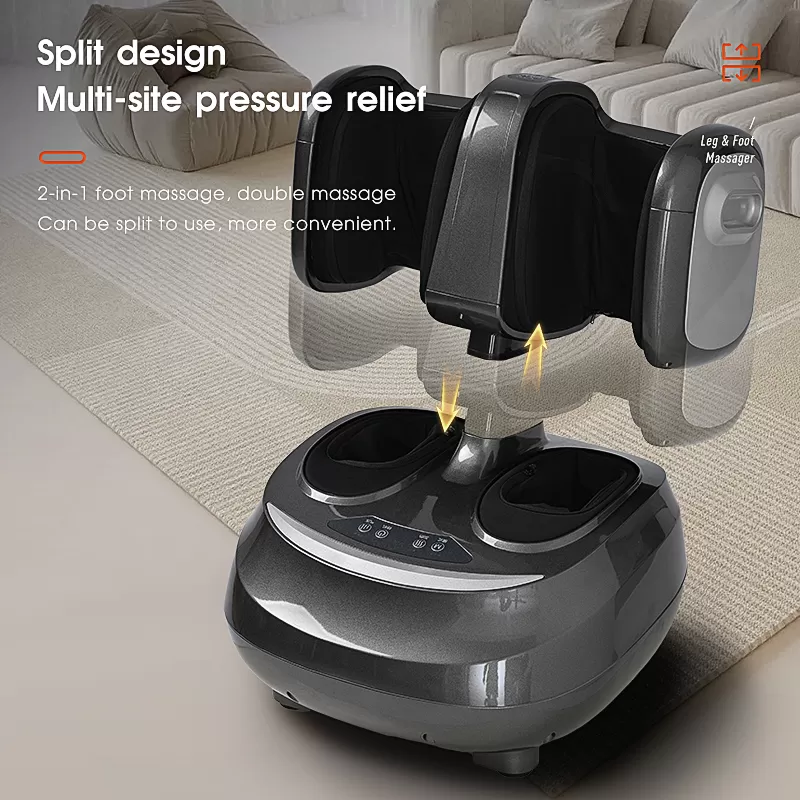
- Therapeutic/High-End Market ($199 - $349+ MSRP): Calf-and-foot combo massagers, real leather finishes, whisper-quiet motors, and app control. This bracket caters to specialty health clinics, high-income households, and premium gift shoppers.
Packaging Optimization to Protect Your Margins
Foot massagers are naturally bulky items. Inefficient box engineering can double your inbound ocean freight and eat into your margins through Amazon FBA dimensional weight surcharges.
Work with your foot massager supplier to reduce hollow dead space inside the master carton. Switching from bulky EPS styrofoam to molded pulp or high-density EPE foam cushions lowers carton volume by 10% to 18%, significantly lowering your cost per unit landed.
5. Brand Sourcing Checklist: 2026 Best Foot Massager Matrix
Use the following evaluation matrix when auditing potential product lines for your brand:
| Evaluation Dimension | Critical Benchmark Specification | Pass / Fail Criteria |
|---|---|---|
| Massage Architecture | Shiatsu nodes + Dual-layer TPU air bladders + Arch scraping | Covers heel, arch, and metatarsals smoothly |
| Acoustic Performance | High-torque BLDC motor, internal sound-damping foam | Operates below 48 dB under full load |
| Thermal Safety | Dual NTC thermistors, auto shut-off, carbon heating wire | Maintains safe temp range (40°C - 45°C) |
| Size Inclusivity | Extended foot cavity or open-frame design | Fits up to US Men's size 12 / EU 46 |
| Maintenance | Removable, high-elasticity zippered inner linings | Machine washable, anti-pilling material |
| International Compliance | FDA registered, CE, RoHS, FCC, UL/ETL certified adapter | Full documentation and lab test reports verified |
| Packaging Efficiency | Optimized dimensional weight, ISTA-2A transit certified | No damaged units during drop testing |
Frequently Asked Questions (FAQ)
Q1: What features define the best foot massager for private label brands in 2026?
A1: The best foot massager combines dynamic air compression, rolling shiatsu mechanisms, and regulated carbon fiber heating inside an aesthetically pleasing enclosure. For commercial brands, it must run quietly (under 48 dB), include washable liners, hold valid safety certifications (such as FDA and CE), and offer compact packaging to limit freight expenses.
Q2: How can my brand reduce return rates on foot massagers sold online?
A2: High return rates usually stem from three causes: machines fitting too tightly on larger feet, overly aggressive mechanical pressure that causes pain, or inadequate heat. To reduce returns below 3%, choose an ergonomic chassis that fits up to US size 12, select air-cushioned kneading nodes instead of bare plastic rollers, and provide gentle low-intensity presets for sensitive users.
Q3: Is an EMS foot mat or a motorized Shiatsu machine better for a commercial product line?
A3: It depends entirely on your retail channel and pricing model. EMS pads cost less to manufacture and ship, but they run higher return rates because users perceive electrical impulses differently. Motorized Shiatsu and air-compression machines yield higher customer satisfaction, deliver immediate physical comfort, and justify premium pricing between $99 and $179.
Q4: What certifications are mandatory when importing a foot massager into the US and Europe?
A4: For the United States, you need an FDA establishment registration, FCC compliance for electronic controls, and an NRTL safety mark (like UL or ETL) for power adapters. For Europe, the product must hold CE, RoHS, and REACH certifications, along with Low Voltage Directive (LVD) and Electromagnetic Compatibility (EMC) testing documentation.
Q5: What is the typical Minimum Order Quantity (MOQ) for a customized foot massager?
A5: Most OEM factories set the baseline MOQ between 500 and 1,000 units for custom logo printing, customized colors, and translated retail packaging. For ground-up ODM tooling with proprietary industrial designs, production runs typically require an initial commitment of 2,000 to 3,000 units to amortize mold expenses.
Launch Your Next Best-Selling Foot Massager
Succeeding in the consumer recovery space requires smart timing, proven design, and reliable manufacturing. Adding the best foot massager to your catalog can drive sustainable revenue, capture high-margin repeat sales, and reinforce your reputation for quality.
Do not let poor engineering choices or shipping inefficiencies eat into your margins. Jingtuo offers end-to-end ODM and OEM manufacturing services, helping international brands build dependable, FDA-compliant, and beautifully designed personal care appliances.
Ready to build the best foot massager line for your brand in 2026? Submit your inquiry today to request a product catalog, review our factory audit credentials, or order your initial custom prototypes.
.webp "How to Choose the Best Foot Massager for Your Brand in 2026")
.webp "The 2026 Back Massager Market: How Contract Manufacturers Are Redefining Ergonomics")
.webp "OEM vs. ODM Foot Massager Sourcing in 2026: Cost, MOQs & Quality Control")